Datos técnicos
Datos técnicos
- Fecha de observación: 2026-10-10
- Lugar: BEGUES – UTAH
- Telescopio: SEESTAR S50 PRO – Tel. 28cm
- Filtro: IRCUT
ESPAÑOL
🌟 SN 2026sqf: 87 días de evolución del color
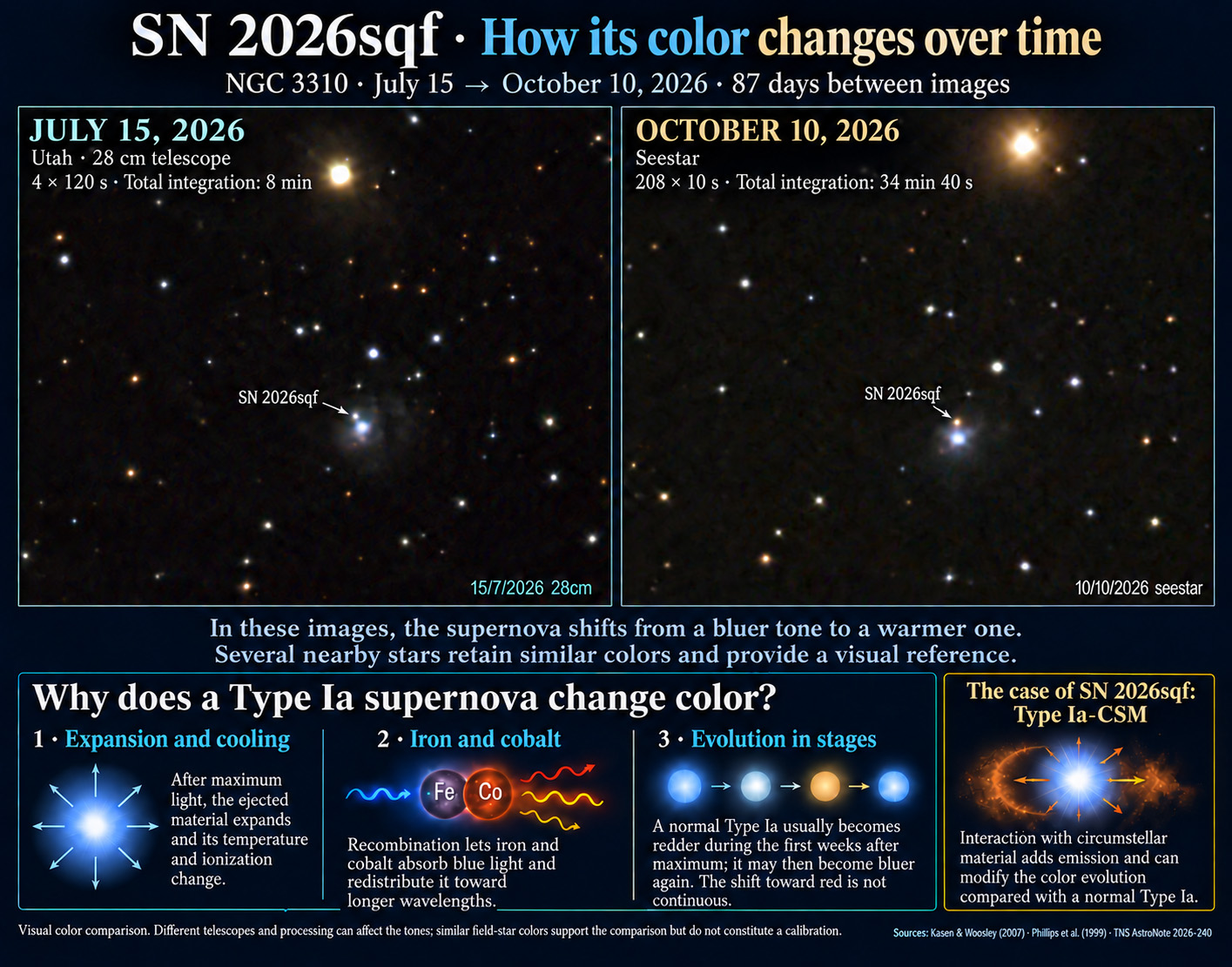
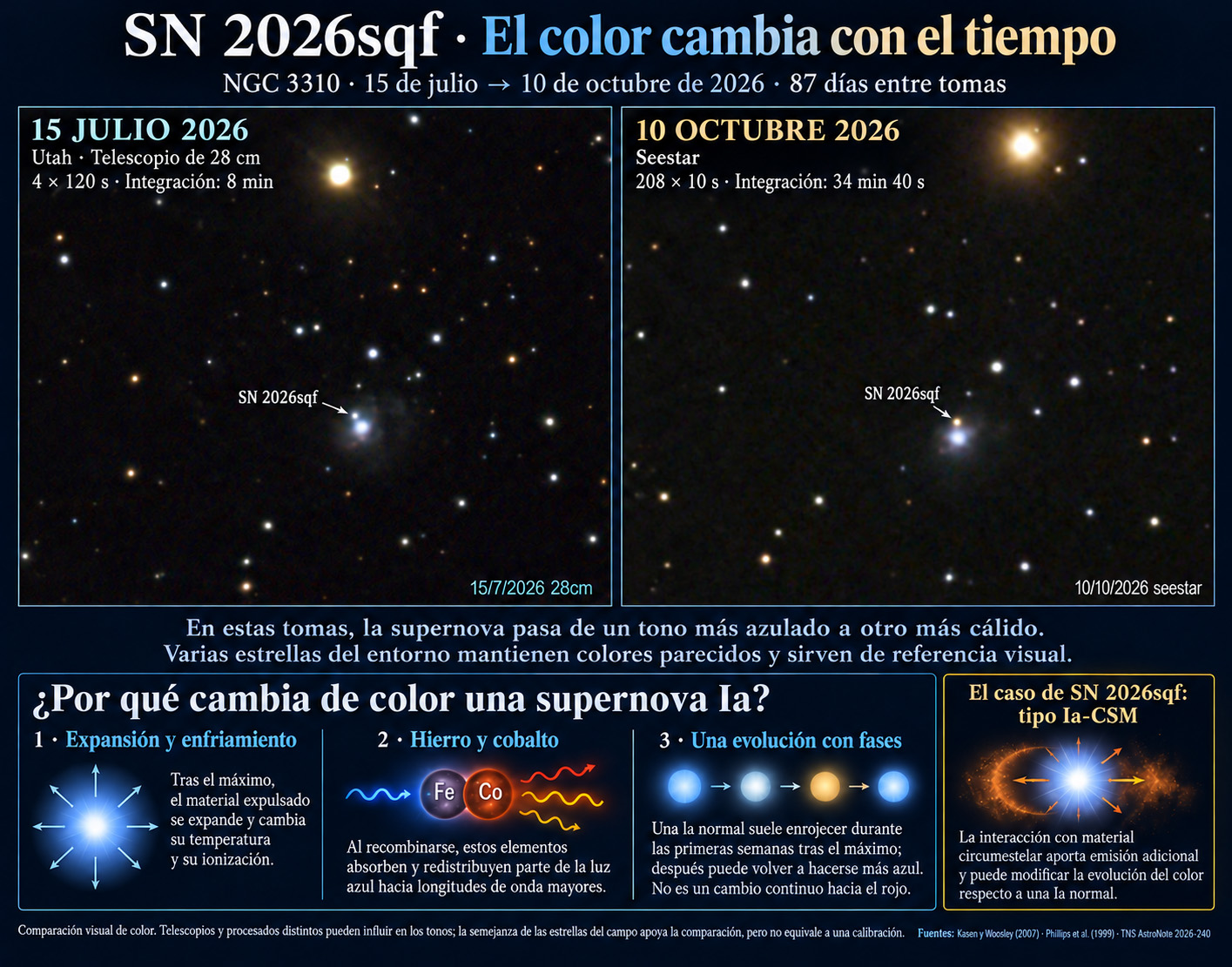
Entre el 15 de julio y el 10 de octubre de 2026, SN 2026sqf muestra un cambio visible: su aspecto pasa de más azulado a más cálido. Varias estrellas del entorno conservan tonos parecidos y ofrecen una referencia visual útil, aunque las diferencias entre telescopios y procesados también pueden influir en el color registrado.
Tras el máximo de una supernova Ia, el material expulsado se expande y se enfría. El hierro y el cobalto cambian de ionización y sus numerosas líneas espectrales absorben y redistribuyen parte de la luz azul hacia longitudes de onda mayores. Por eso, una Ia normal suele enrojecer durante las primeras semanas después del máximo.
Pero hay un detalle sorprendente: ¡después puede volver a hacerse más azul! En muchas Ia normales, el color alcanza su fase más roja aproximadamente un mes después del máximo. Durante las semanas siguientes, el material se vuelve más transparente y cambia la combinación de absorción y emisión que forma su espectro. Ese retorno hacia el azul no significa que toda la supernova vuelva a calentarse: también cambia qué regiones y qué líneas dominan la luz que recibimos.
SN 2026sqf tiene una particularidad adicional: es una Ia-CSM, con interacción entre el material expulsado y material circumestelar rico en hidrógeno. Esa interacción añade emisión, incluida la línea roja Hα, y puede modificar el color. Sin embargo, el tono amarillento de la fotografía no puede atribuirse únicamente al hidrógeno: es el resultado de todas las contribuciones que registra la cámara.
📷 15/07/2026: Utah, telescopio de 28 cm, 4 × 120 segundos; integración total de 8 minutos. 📷 10/10/2026: Seestar, 208 × 10 segundos; integración total de 34 minutos y 40 segundos.
Dos imágenes separadas por 87 días que permiten apreciar la evolución visual del color, sin reconstruir por sí solas toda su trayectoria.
—
ENGLISH
🌟 SN 2026sqf: 87 days of color evolution
Between July 15 and October 10, 2026, SN 2026sqf shows a visible change, shifting from a bluer appearance to a warmer tone. Several nearby stars retain similar colors and provide a useful visual reference, although differences in telescopes and processing can also affect the recorded color.
After maximum light in a Type Ia supernova, the ejected material expands and cools. Iron and cobalt change their ionization state, and their many spectral lines absorb and redistribute some blue light toward longer wavelengths. A normal Type Ia therefore usually becomes redder during the first weeks after maximum.
But there is a surprising detail: it can then become bluer again! In many normal Type Ia supernovae, the color reaches its reddest phase roughly a month after maximum. Over the following weeks, the material becomes more transparent, changing the combination of absorption and emission that shapes the spectrum. This return toward blue does not mean that the entire supernova is heating up again: the regions and spectral lines dominating the light we receive also change.
SN 2026sqf has an additional feature: it is a Type Ia-CSM, with interaction between the ejecta and hydrogen-rich circumstellar material. This interaction adds emission, including the red Hα line, and can modify the color. However, the yellowish tone in the photograph cannot be attributed solely to hydrogen: it results from all the contributions recorded by the camera.
📷 July 15, 2026: Utah, 28 cm telescope, 4 × 120 seconds; total integration of 8 minutes. 📷 October 10, 2026: Seestar, 208 × 10 seconds; total integration of 34 minutes and 40 seconds.
Two images taken 87 days apart reveal a visual change in color, without tracing its entire evolution on their own.